Cuba Reorganizes Its Commercial Network: Neighborhood Markets Displace Traditional Stores
The Cuban government transforms state-owned warehouses into **Neighborhood Markets** managed by the private sector, retaining only 1,913 establishments for rationing. Although the measure aims to reduce prices by 15%, costs remain unaffordable for most of the population facing a supply crisis and extreme poverty.
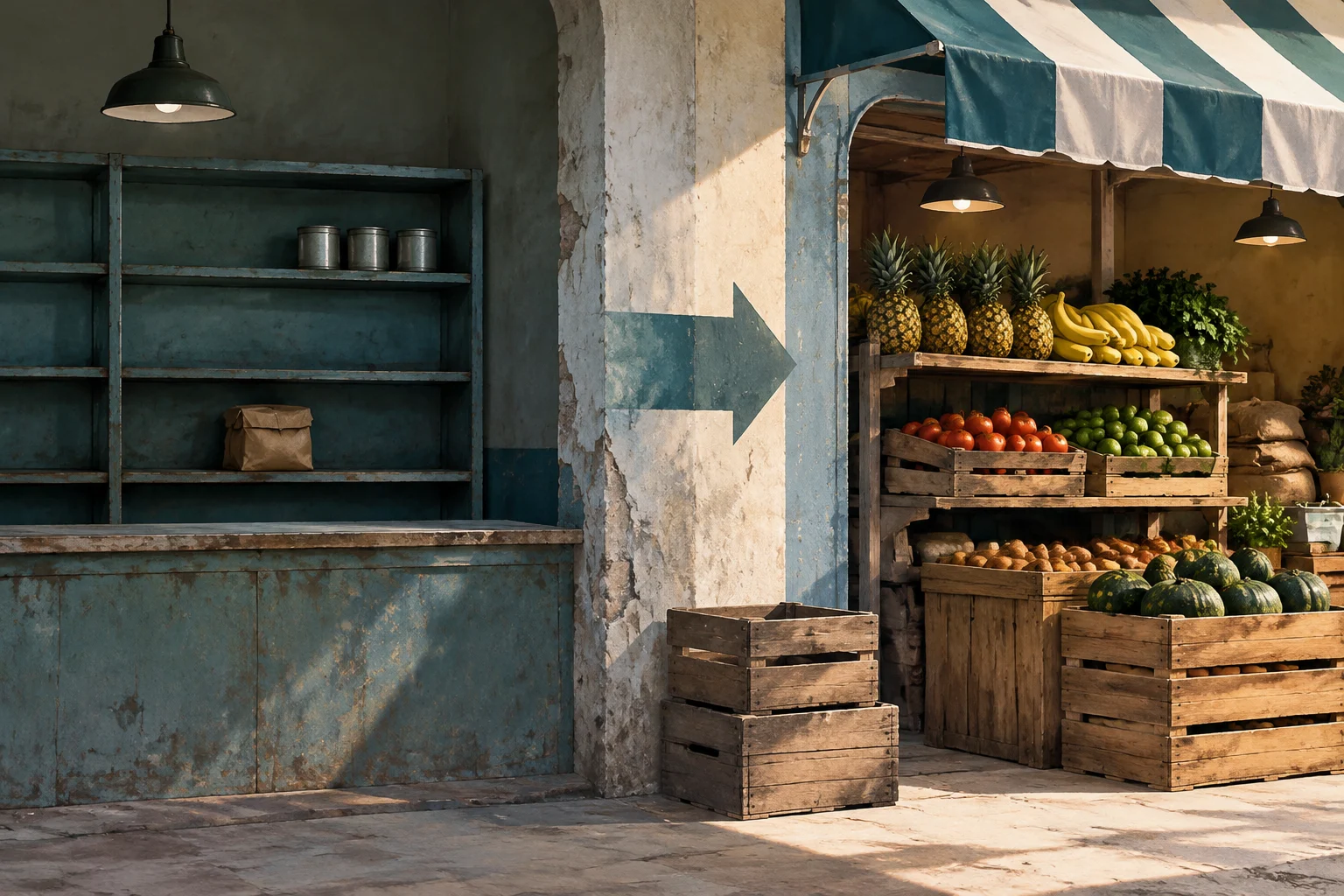
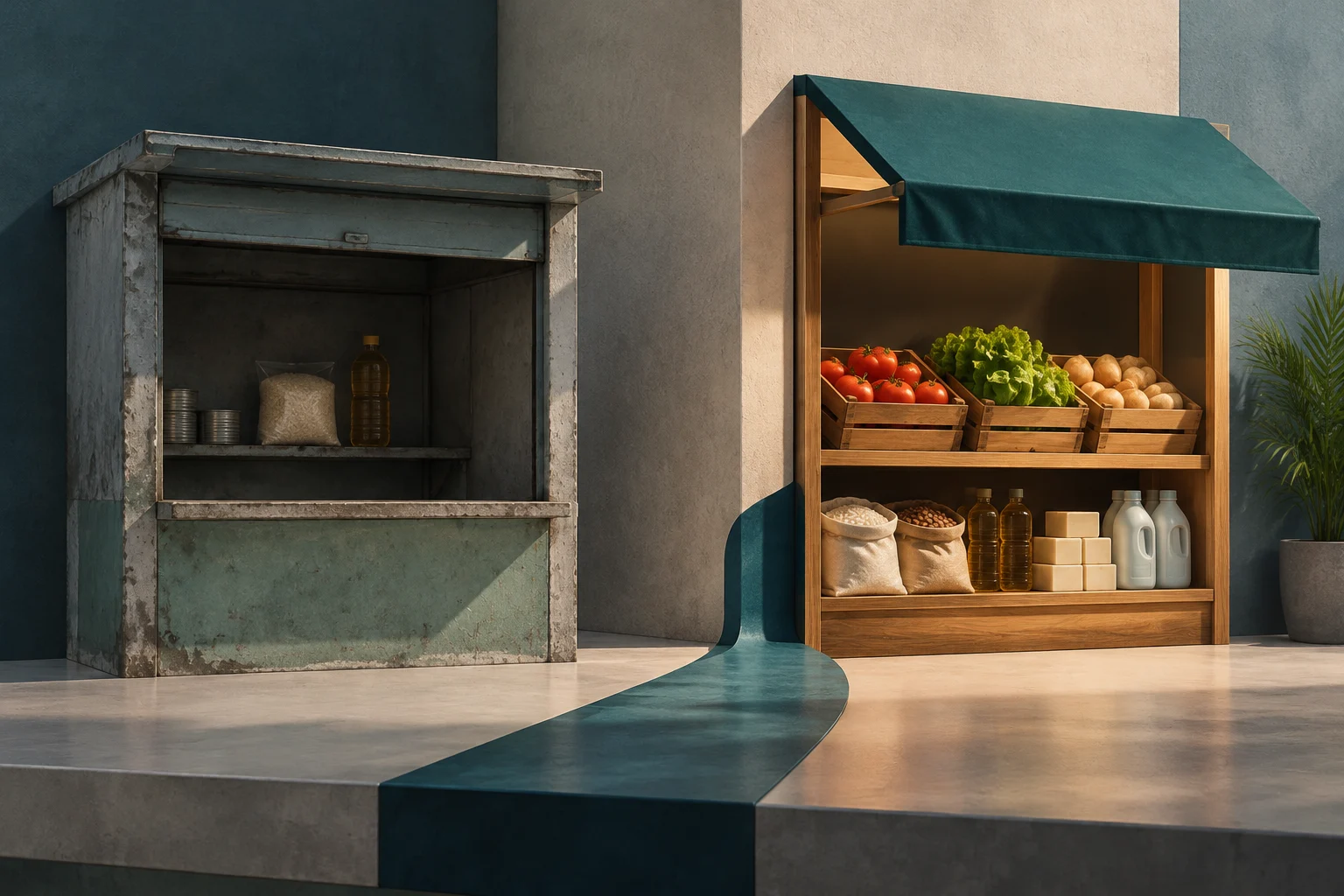
AI-generated conceptual illustration · Edition Business
A Deep Restructuring of Retail Commerce
The food distribution system in Cuba is undergoing a structural change. The government has begun transforming the network of state-owned warehouses into Neighborhood Markets, a model that seeks to integrate private management into the sale of basic goods. This measure, regulated by Resolution 16/2026 from the Ministry of Interior Commerce, does not formally eliminate the ration book but redefines the role of traditional establishments in everyday economics.
From State Monopoly to Mixed Management
The new regulation allows stores to be managed by SMEs, non-agricultural cooperatives and self-employed workers, as well as state companies. Management is granted through lease or tender, with priority given to staff who already operated in those spaces. In exchange for taking on commercial responsibility, managers can access tax advantages and be exempt from paying rent.
Although the official goal is to increase supply and reduce final prices, the reality on the ground shows a more complex scenario. Resolution 16/2026 sets the sale of 16 basic foods and five hygiene products, ending the state monopoly over part of retail trade, although it does not resolve foreign currency access limitations or guarantee supply stability.
The Reduction of the Rationed Network
The scope of the transformation is significant. According to data confirmed by Marpessa Portal de Villiers, Director General of Merchandise Sales at the Ministry of Interior Commerce, the government has selected 1,913 warehouses to maintain their traditional rationing function. This figure represents only 16% of the more than 12,000 units that make up the state network.
The rest of the establishments will be progressively transformed. In provinces such as Cienfuegos, a "mother warehouse" scheme is projected in each Popular Council to concentrate distribution to vulnerable people, while other locations adopt purely commercial functions. To date, between 37 and 47 establishments have been reported active under the new format, depending on source and counting date.
Prices and Purchasing Power: The Persistent Gap
The central promise of Neighborhood Markets is to offer products up to 15% cheaper than in the private market. However, media coverage and consumer testimonies indicate that prices remain prohibitive for most of the population.
In the Ayestarán market, Havana, a liter of oil was around 2,600 pesos, powdered milk cost 4,500 pesos and rice 800 pesos. These values, similar to those in the informal market, have sparked protests among customers. América Guillén, an 82-year-old retiree, told AFP: "I am 82 years old and my pension is 3,000 pesos. Coming here to this market is only for buying a bottle of oil and that's it."
Context of Crisis and Vulnerability
This reorganization comes at a time of acute economic crisis. A report from the Cuban Human Rights Observatory (OCDH) indicates that 94% of Cubans live in extreme poverty and 80% have experienced food insecurity in the last year. In this context, reducing the subsidized warehouse network directly impacts the most vulnerable sectors, such as retirees, children and single mothers, who are the main beneficiaries of the maintained ration book.
Radimir Galán, a Cuban activist, told Martí Noticias that "prices there will be supply and demand. There will be no subsidized prices in those new locations." This statement underscores the paradigm shift: the State stops being the sole provider and moves to regulate a market where commercial logic prevails over universal subsidy.
Supply and Logistics Challenges
Official press acknowledges difficulties in maintaining product availability in the new markets. Not all establishments consistently have most of the items planned. The fuel crisis and the country's production incapacity continue to limit supply. In May 2026, it was noted that several state warehouses in Havana remained practically empty, with official consignments occupying more space than available products.
The transformation is not only administrative but also constructive. Stores are being adapted for the new sales system, which implies investments in infrastructure and logistics. However, the lack of a unified national disposition on the exact "mother warehouse" model creates uncertainty about how the system will be implemented across all provinces.
What to Watch Now
The real impact of Neighborhood Markets will depend on the government's ability to ensure product flow and private sector response to tax incentives. Price trends in the coming months will be a key indicator of whether the measure achieves its goal of reducing basic basket costs or becomes another sales space with market prices, without expected benefits for the most vulnerable population.
Valeo CEO Christophe Perillat calls for vehicles sold in Europe to incorporate at least 75% local components to prevent massive job losses. This request aligns with the EU's 'Industrial Accelerator Act' draft, which considers raising the origin threshold for accessing public aid, generating concern in Spain over the risk that its factories may not meet the new criteria.
The BOE has published RDL 28/2026 and 29/2026, which introduce urgent measures such as the suspension of evictions for vulnerable groups, automatic lease extensions, and a 10 billion euro fund for home purchases. RDL 28/2026 will enter into force on November 15, 2026, subject to ratification by the Permanent Delegation, while RDL 29/2026 regulates the automatic extension of contracts.
The parent company of 28 by Sam Wood has immediately ended all commercial agreements with its founder after he was charged with assault and strangulation. The brand will continue under the leadership of Mark Watkin while several partners and influencers cut their ties.