Guide for integrating connected machinery with MES and ERP systems: protocols, security and costs
Effective integration between the plant and the business requires an open architecture that decouples OT control from IT data flows. This guide details how to normalize legacy protocols through gateways, define data semantics with standards such as ISA-95 and PackML, and establish intrinsic cybersecurity to minimize costs and dependencies.
In many industrial companies, two technological realities coexist that rarely communicate fluidly. On one hand, the OT (Operational Technology) environment, composed of PLCs, sensors, SCADA systems, and machinery that generate continuous information in the plant. On the other hand, the IT (Information Technology) environment, which includes ERP, MES, cloud platforms, and Business Intelligence tools. The problem arises when these worlds are not truly connected, causing production data to be manually entered into the ERP, discrepancies to exist between production and business information, and a reliance on spreadsheets to consolidate indicators.
IT/OT integration is not just about connecting machines, but about ensuring that industrial data is accessible, reliable, secure, and useful for decision-making. The real challenge is to convert raw industrial data into contextualized information that the entire organization can use.
Layered architecture: from sensor to ERP
A robust integration architecture connects different technological layers in a hierarchical manner. At the operational level, machines and sensors generate variables such as temperature, pressure, speed, or machine states. This information flows to SCADA systems or IIoT platforms, which in turn connect with the MES (Manufacturing Execution System) and, finally, with the ERP.
The simplified flow is represented as follows:
Machines and sensors
PLC / SCADA
MES / Data Platform
Cloud
ERP / BI / AI
However, the technical connection is only half the process. For the integration to deliver value, it is essential to contextualize the data. It is not enough to know that a machine has recorded a temperature; it is necessary to know which equipment it belongs to, what product was being manufactured, which production order was being executed, and in which shift the event occurred. This context is what turns an industrial data point into useful business information.
Roles of key systems
Each system performs a specific function in this value chain:
SCADA: Provides real-time visibility and control of industrial processes, collecting information directly from automation equipment.
MES: Acts as the fundamental layer between operations and enterprise systems. It manages production execution, relating orders, materials, processes, machines, quality, and performance. Its objective is to ensure that manufacturing operations are executed effectively through the collection of precise real-time data.
ERP: Offers the global business view, managing planning, purchasing, inventory, sales, and finance. It benefits from MES information to optimize planning and costs.
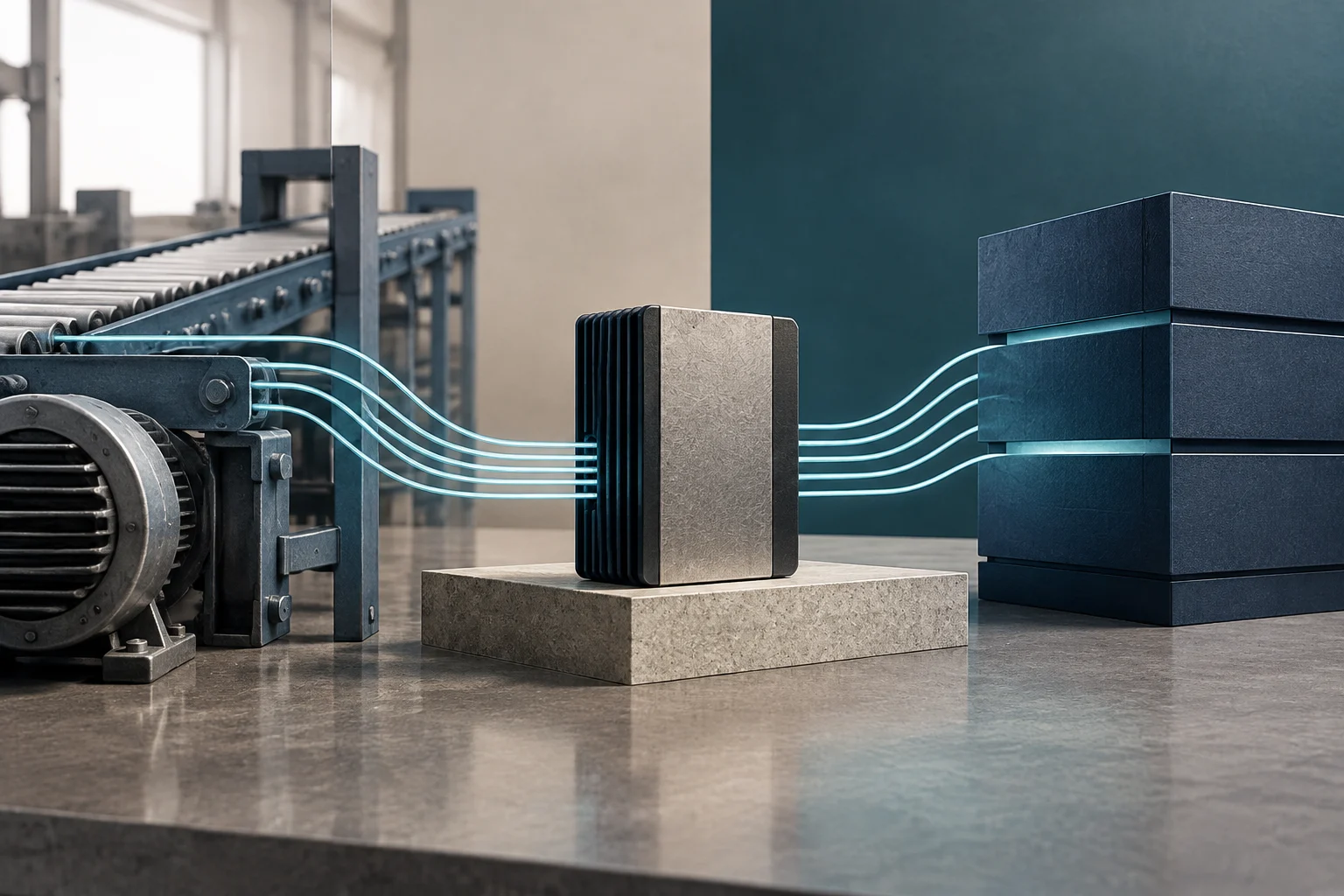
Illustration conceptuelle générée par IA · Edition Business
Interoperability and protocol normalization
The main technical challenge is integrating heterogeneous equipment from different brands and generations. The solution lies in adopting open architectures that decouple real-time control from data flows. This is achieved through layer separation and semantic interoperability.
The role of gateways and protocols
The process begins with an asset inventory, identifying legacy protocols such as Modbus RTU/TCP, PROFINET, EtherNet/IP, or BACnet. A gateway or perimeter controller acts as a translator and normalizer: it captures these protocols and publishes the already contextualized data using modern standards such as OPC UA or MQTT.
OPC UA: Provides a rich information model, namespaces, navigation, and integrated security. It is ideal for exposing plant data to OT/IT consumers in a standardized way.
MQTT: Enables lightweight communication based on the publish/subscribe model, very efficient for remote links, distributed fleets, or when scaling consumers with minimal friction is needed.
Data semantics: ISA-95 and PackML
It is not enough to "read tags"; it is necessary to consistently describe the meaning of each variable and its context. For this, specific standards are used:
PackML (derived from ISA-88): Unifies machine states and modes in discrete and packaging lines. This makes events such as startups, stops, or errors mean the same thing in equipment from different suppliers, facilitating integration.
ISA-95 / IEC 62264: Defines the exchange of information between control, MES, and ERP. Its implementation in B2MML (XML schemas) allows establishing clear data contracts for production orders, materials, genealogy, and consumptions.
RAMI 4.0 and Asset Administration Shell (AAS): Promote that each asset has a "digital ID card" with interoperable submodels throughout its lifecycle, accelerating startups and recipe changes.
Cybersecurity and data governance
Security must be intrinsic to the architecture design, not a later addition. Integration must not compromise the availability or integrity of the production process.
Essential security measures
Network segmentation: Isolate control loops from business data flows.
TLS encryption: Essential in communication between gateways, brokers, and consumers.
Authentication and authorization: Use of certificates and role-based access control to ensure that only authorized systems access the information.
Governance and interface contracts
Integrating is also governing. To minimize maintenance costs and dependence on specific suppliers, it is recommended to:
Define a data contract per object (machine, line, batch) with versions and change control.
Establish data quality owners.
Document the provenance and acceptable latency for each use case.
This governance allows the architecture to be scalable, facilitating testing and staged deployments, and enabling multi-site management without the need to redesign the infrastructure at each new location.
Conclusion
The integration of connected machinery with MES and ERP systems is not just a technical project, but a business strategy. By adopting open architectures, normalizing protocols through gateways, and defining a clear data semantics, companies can eliminate information fragmentation. This results in a significant reduction in total cost of ownership, greater agility in decision-making, and a solid foundation for future implementations of Artificial Intelligence and Industry 4.0.
Un guide pratique pour définir, mesurer et évaluer la performance des processus automatisés. Apprenez à établir des lignes de base, à sélectionner des indicateurs d'effort, de qualité et de coût, et à calculer le ROI réaliste pour décider de maintenir, d'ajuster ou de réverser l'automatisation.
Une stratégie de sauvegarde utile commence par hiérarchiser les informations et déterminer quelle perte de données et quelle durée d’interruption l’entreprise peut tolérer. Cela permet de définir la fréquence, le stockage et les tests de restauration.
Organisez les accès des employés et des fournisseurs en quatre étapes : identifier les comptes et les responsables, renforcer l'authentification, limiter les permissions et révoquer les accès lorsqu'ils ne sont plus nécessaires.