Private 5G or Wi-Fi 6: How to Choose for an Industrial Project
The decision depends on the environment, mobility, and the requirements of each application. Wi-Fi 6 is often a good fit for indoor settings with static equipment; a private 5G network may be more suitable for large areas, mobile devices, or more predictable connectivity needs. In many projects, the two technologies complement each other.
In an industrial project, comparing Wi-Fi 6 with a private 5G network is not about determining which technology is better in the abstract. The decision depends on where the equipment will connect, how it will move, what level of continuity each application requires, and what infrastructure already exists at the plant.
Wi-Fi is often a practical option for connecting devices inside buildings, especially if they remain in fixed locations and the existing wireless network provides adequate coverage. Private 5G may be relevant when outdoor areas or multiple buildings need coverage, when moving equipment needs service, or when applications require more controlled performance. None of these advantages is automatic: the outcome depends on the design and site conditions.
Coverage and Mobility
Wi-Fi access points cover relatively limited areas. In a large factory, a warehouse with obstacles, or a site with separate yards and buildings, extending coverage may require more equipment, cabling, and planning to avoid dead zones or interference. Metal structures, walls, and neighboring networks can also affect performance.
The cellular technology used by a private 5G network can cover larger areas per radio site, although actual coverage depends on the spectrum band, permitted power, plant layout, and materials present. This architecture can be useful for automated guided vehicles, mobile robots, or staff moving between areas. Wi-Fi also supports mobility, but roaming between access points and continuity must be tested in the specific environment, especially for applications sensitive to interruptions.
Latency, Capacity, and Predictability
Latency—the time it takes information to travel from one device to another—is not determined solely by the wireless standard. Congestion, coverage, configuration, the transport network, and the systems processing the data all play a role. The sources consulted describe low latency for both technologies under favorable conditions, but also note that heavy traffic or poor coverage can affect Wi-Fi performance. Commercial figures cited for 5G networks should not be treated as a guarantee that applies to every installation.
In 5G, radio resource management and quality-of-service features can help allocate capacity to particular devices or applications, depending on the deployed solution. This can be valuable when sensors, cameras, and mobile equipment with different priorities share the network. Wi-Fi 6, for its part, can support numerous devices and improve efficiency in dense networks, but performance depends on the number of clients, traffic, and access point design.
For automation, robotics, or real-time control, it is advisable to first define the latency, latency variation, and availability limits required by the application. These should then be verified through representative testing: a technology label alone does not prove that the network meets those requirements.
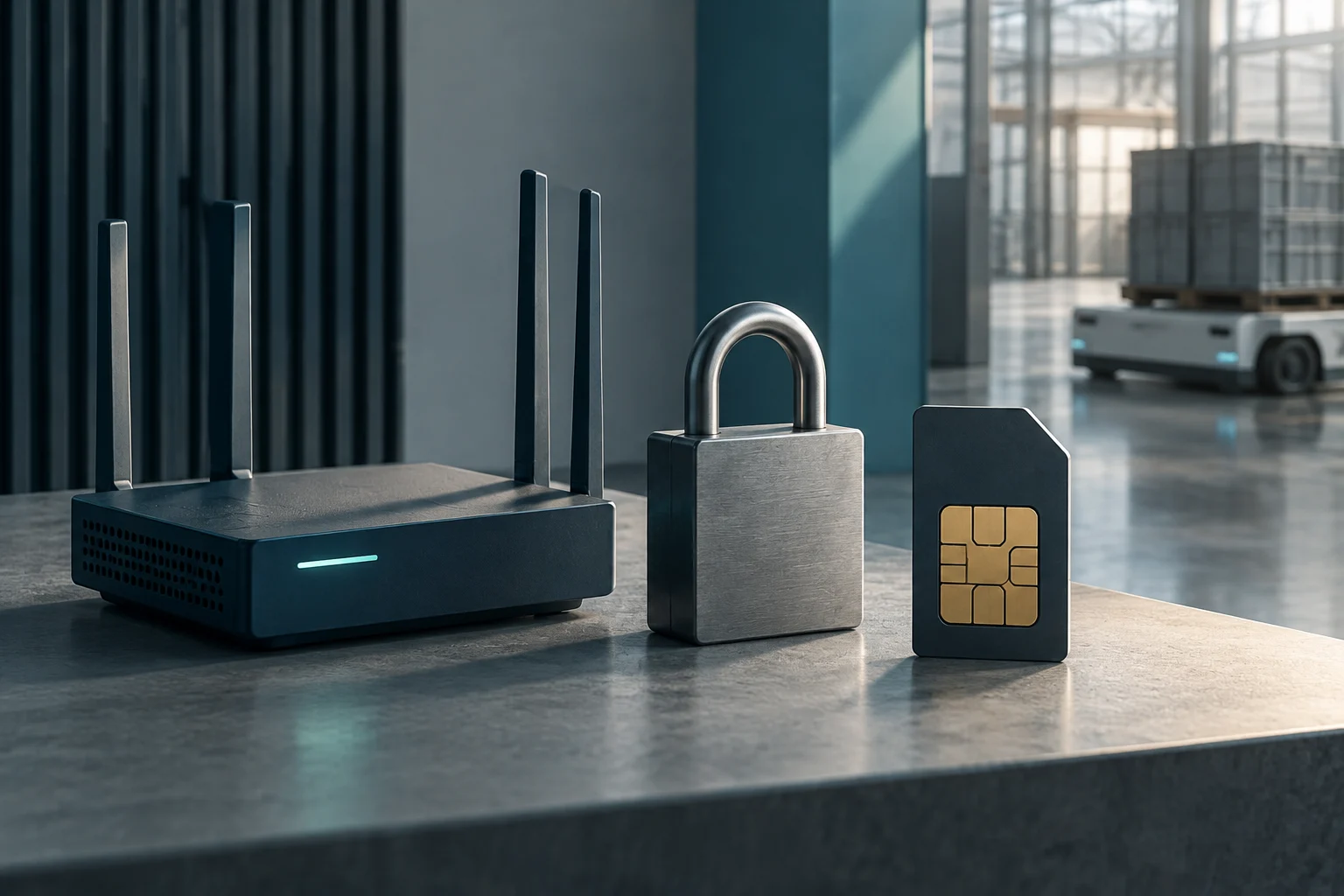
AI-generated conceptual illustration · Edition Business
Security and Device Compatibility
Both options have security mechanisms, but how they are applied and managed varies. Enterprise Wi-Fi can use robust authentication and encryption, for example with WPA3 and 802.1X, if the devices and configuration support them. A private 5G network can use SIM or eSIM to authenticate devices and apply centralized access policies.
This does not mean that either technology is secure without proper management. The company should also consider device inventory, segmentation, credential updates, monitoring, and incident response. Compatibility is another practical factor: many laptops, phones, and tablets include Wi-Fi, whereas industrial devices connecting to private 5G need compatible radios or modules and, depending on the design, a SIM or eSIM. This adaptation can affect the project schedule and cost.
Deployment and Operating Costs
Wi-Fi is often easy to get started with when infrastructure already exists and the goal is to cover limited indoor spaces. However, extending a network outdoors, to separate buildings, or to areas with obstacles can increase the number of access points, cabling, and operational work.
A private 5G network may require investment in radios, a network core, integration, and management, as well as arrangements for spectrum access. Its cost cannot be reliably compared with Wi-Fi without knowing the scope, the number and type of devices, availability requirements, and operating model. Some managed offerings reduce the initial investment, but their terms and recurring costs depend on the provider and service.
Spectrum deserves specific attention. The sources mention CBRS, a shared band regulated in the United States; that framework or its conditions should not be assumed to apply in other countries. Frequency availability and authorizations depend on the project’s jurisdiction.
Comparison by Criteria
Criterion
Wi-Fi 6
Private 5G Network
Typical environment
Indoors and limited areas
Large sites, outdoors, or multiple buildings, depending on the design
Equipment
Broad compatibility with office devices
Requires equipment or modules compatible with the network and its spectrum
Mobility
Suitable if coverage and roaming between access points are well planned
Can fit operations involving equipment moving around the site
Traffic management
Depends on network design, load, and configuration
May offer allocation and prioritization mechanisms, depending on the solution
Security
Requires authentication, encryption, and policies to be configured and maintained
Can use SIM/eSIM authentication and centralized policies
Cost
Often economical for straightforward indoor deployments
Depends on architecture, spectrum, scale, and service model
When to Combine the Two
There is no need to choose just one technology for the entire plant. A hybrid architecture can reserve Wi-Fi for computers, tablets, and other general-purpose devices indoors, and use private 5G where mobility, broad coverage, or differentiated management of industrial applications matters more. The integration should define how the two networks connect, who manages them, and which policies apply to each type of device.
Before preparing a proposal, it is advisable to map coverage, identify obstacles and sources of interference, check existing devices, and classify applications by their requirements. It is also useful to test the options in critical areas and compare not only the initial installation, but also expected maintenance and operations.
Decision criterion: Wi-Fi 6 may be sufficient for indoor connectivity with mostly static equipment. A private 5G network merits consideration when a project requires broad coverage, mobility, or more controlled traffic management. If the plant has both types of need, a combined solution may be a better fit than a complete replacement.
Effective digital order management connects order intake with inventory, preparation, delivery, and invoicing. The first step is not choosing software, but understanding the process and deciding which system should cover each stage.
A good comparison starts with the center’s workflows, not the provider’s feature list. These criteria help assess integration, privacy, patient experience, implementation, and total cost.
Before automating, assess the objective, data, impact of errors, oversight, risks, and total cost. This checklist helps you decide whether to test, adjust, or postpone a deployment.