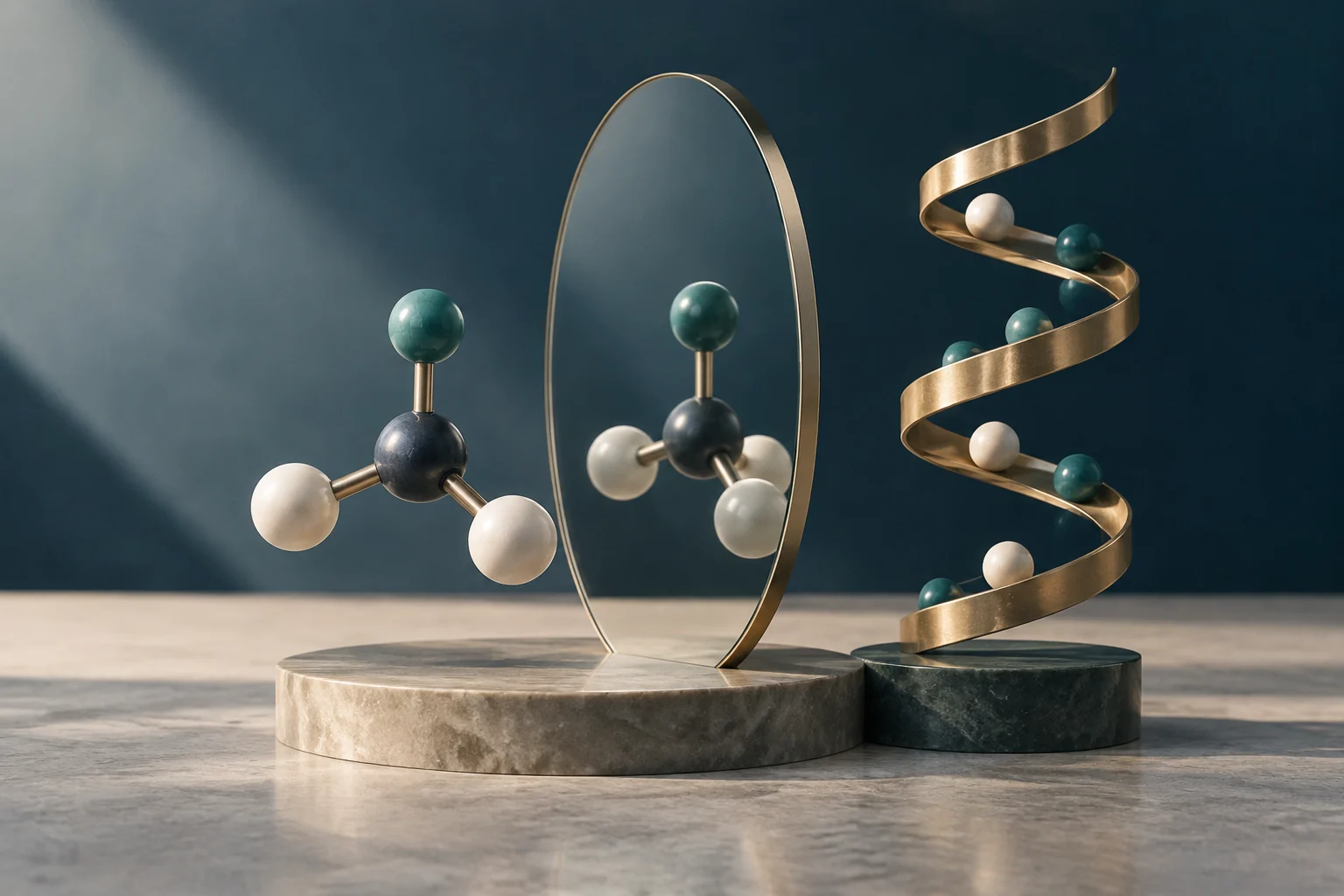
The Royal Swedish Academy of Sciences awarded the 2026 Nobel Prize in Chemistry to Henri B. Kagan and Kenso Soai for their discoveries concerning nonlinear effects and autocatalysis in asymmetric organic synthesis. Their research shows how a reaction can favor one mirror-image form of a molecule and amplify that advantage during the process.
The recognition is linked to a longstanding question in chemistry: why many molecules essential to life appear predominantly in one of their two spatial orientations. The findings provide tools for studying this phenomenon, but do not constitute a definitive explanation for the origin of molecular asymmetry in living organisms.
Why a molecule’s “handedness” matters
Some chiral molecules exist in two forms that are mirror images of each other, like right and left hands. Although they have the same composition, their shapes cannot be superimposed, and they can interact differently with other molecules. In organisms, for example, the amino acids in proteins are almost always found in one orientation, while the sugars in DNA and RNA have the opposite orientation.
In many chemical reactions without a factor that tips the result, similar amounts of both forms are produced. Asymmetric synthesis, by contrast, aims to favor the production of one of them. This is relevant to designing molecules intended to interact with biological systems, including drugs: orientation can influence how a substance behaves. This context does not mean that the Nobel-recognized findings are a clinical evaluation of medicines, nor that all mirror-image molecules have different or harmful effects.
From amplification to autocatalysis
In 1986, Kagan described a nonlinear effect in which a small difference in the composition of catalysts can translate into a larger difference in the reaction rate. In practical terms, the result does not always bear a simple proportion to the starting mixture: certain combinations can favor the formation of one of the mirror-image forms more than others.
Soai later developed an autocatalytic reaction. In this type of process, the product formed helps catalyze its own production, which can amplify an initial advantage. According to coverage of the announcement, Soai described a design with autocatalytic potential in 1995 and presented a reaction in 2003 that produced one of the mirror-image forms in a far greater proportion than the other.
Applications and limits of what is known
Controlling which form is produced can be useful in the research and manufacture of chemicals intended to interact with organisms, including pharmaceutical and agrochemical compounds. It may also be relevant to aromas, fragrances, and some materials. The specific importance depends on the substance and its production process: the Nobel recognizes scientific principles and contributions; it does not, by itself, guarantee particular commercial applications or therapeutic benefits.
Soai’s autocatalysis also provides an experimental model for exploring how a small initial asymmetry might have been amplified in certain chemical scenarios. However, the reaction studied is artificial and does not, by itself, reproduce the origin of life. Its value lies in demonstrating a possible amplification mechanism, not in conclusively resolving how some molecular forms came to predominate over others on the early Earth.