How to Reduce Food Waste in a Restaurant Without Affecting Service
A practical method for measuring waste, adjusting purchases and food preparation, improving stock rotation, and reviewing results without losing sight of the customer experience or the applicable requirements in Spain.
Reducing food waste does not require starting by changing the menu or serving portions that leave customers unsatisfied. The first step is to find out what is being thrown away, at what stage, and why. With this information, the restaurant can take action on purchasing, storage, preparation, and service, and check whether the changes reduce waste without harming the quality or availability of dishes.
1. Establish a baseline before changing processes
For an initial period, record the food being discarded and classify it by stage: products that expire or spoil, preparation trimmings, kitchen errors, surplus production, and food returned from tables. Also note the quantity and the reason. A shared spreadsheet can be used to get started; what matters is that the team follows consistent criteria and records data during all relevant shifts.
It is useful to link waste to the service it relates to and to the level of activity. This makes it possible to distinguish, for example, the usual surplus from a particular dish from exceptional production caused by a reservation or an event. There is no need to measure everything in the same level of detail from day one: starting with the most frequent categories helps identify where action is worthwhile.
2. Adjust purchasing and forecasts to actual demand
Review available sales, reservation, occupancy, or event records to identify demand patterns. Compare these forecasts with inventory and suppliers’ delivery times before placing each order. The aim is to avoid both excess stock and ingredient shortages during service.
Set replenishment levels for regular products and review them when the season, menu, or sales pace changes. If an ingredient is used in several dishes, its turnover may be more predictable; if it appears only in a preparation that sells infrequently, pay particular attention to how much is purchased and how often.
3. Improve storage and stock rotation
An orderly receiving process makes subsequent checks easier. Identify products and their dates, store them under the appropriate conditions, and place older food where it will be used first. This rotation—known as FIFO: first in, first out—reduces the risk of a product being forgotten behind a recent delivery.
The routine should fit the kitchen’s operations: agree on who checks stock, when it is checked, and how products that are nearly depleted or at risk of spoiling are communicated. It is also useful to record losses caused by spoilage or improper storage; if they recur, the problem may lie in the process rather than in the quantity purchased.
AI-generated conceptual illustration · Edition Business
4. Standardize preparation and portions
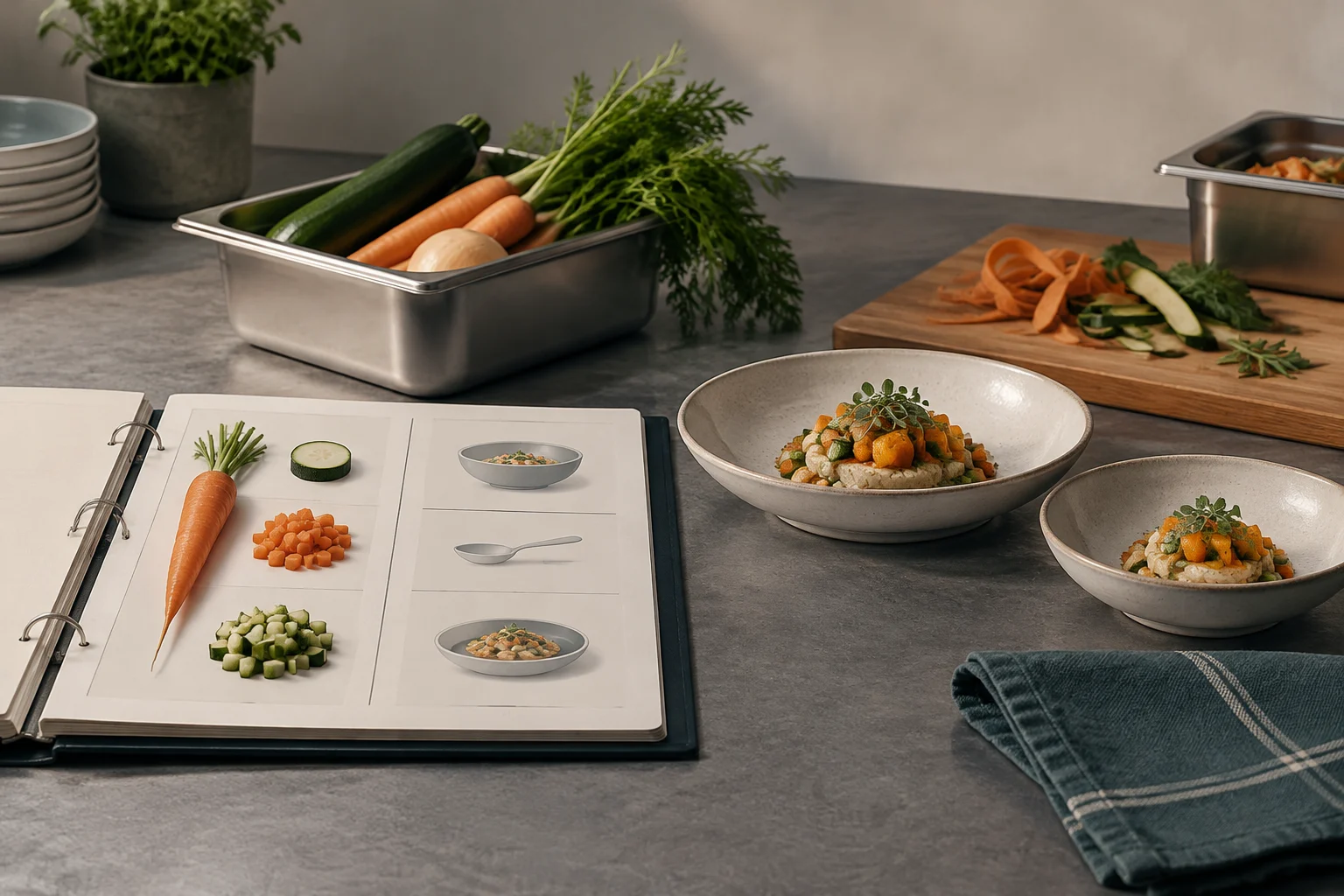
Recipe sheets help maintain consistent quantities and results across shifts. Specify ingredients, expected yield, portion size, and preparation guidelines. This makes it easier to calculate how much to prepare and identify differences between the planned quantity and the amount actually used.
Also review trimmings and preparation errors. When appropriate for the recipe and food safety, some ingredients can be used in more than one preparation. The aim is not to reuse food without a clear rationale, but to plan safe and coherent uses as part of menu design.
Portions should also be reviewed based on observation: compare what is served with what comes back from tables, and ask the team whether certain dishes regularly generate leftovers. Before changing a portion, consider the effect on customer satisfaction and presentation. One alternative is to offer size options when they fit the restaurant’s concept and service.
5. Manage production during service
In buffets and services with variable demand, producing in batches and replenishing according to what is being served can limit surplus, provided an adequate selection remains available to customers. In the kitchen, clear preparation plans for each shift and effective communication between front of house and kitchen help reduce duplication, errors, and remade dishes.
Agree on what to do when demand differs from the forecast: who can adjust production, how availability is communicated, and what alternatives are offered if a dish runs out. This way, reducing surplus does not depend on improvisation in the middle of service.
6. Review results alongside service
Regular monitoring makes it possible to see whether measures are working or merely shifting the problem to another stage. At a minimum, review the quantities discarded by category, the associated cost where it can be calculated, and how these figures change in relation to the level of activity. Add service indicators, such as product shortages, delays, complaints, or returned leftovers, to ensure that reducing waste does not come at the expense of the customer experience.
If a measure does not improve results, first check the quality of the records and whether it is being applied consistently across all shifts. Then adjust the process and measure again. Brief, practical staff training is important: everyone should know what to record, how to store products, and whom to inform about an issue.
What to consider in Spain
Law 1/2025 on the prevention of food loss and food waste is the Spanish regulatory reference mentioned in the material consulted. That material attributes to the law obligations for hospitality establishments relating to enabling customers to take leftovers home, informing them of this option, and using appropriate containers; it also notes an exception for all-you-can-eat buffets and charging requirements when certain single-use plastic containers are used.
The precise scope of the obligations may depend on the establishment’s activity and circumstances. Before applying these guidelines, confirm the legislation in force and the requirements applicable in Spain, including those relating to containers and food safety. This operational guide does not replace that legal verification.
An improvement plan that does not interrupt operations
Start with a simple record and choose one or two recurring causes to address. Assign responsibilities, incorporate changes into purchasing or kitchen routines, and review the data with the team at regular intervals. Measure, adjust, and measure again to reduce losses gradually, using decisions based on the restaurant’s actual activity and giving explicit attention to service quality.
The decision depends on more than the price of the sensors: it requires comparing the system’s total cost with the cost of breakdowns it could help prevent. A reliable baseline and a pilot test make it possible to assess the results at the plant itself.
Standardizing does not mean treating every customer the same. It means defining the steps, responsibilities, and checks that must be maintained, and making clear where the service can be adapted.
Start with the process that combines volume, repetition, and measurable problems, not the most eye-catching tool. A simple method helps compare impact, effort, risks, and results before expanding the investment.