Returns and warranties in an online store: a guide for businesses
What information to provide before purchase, when the 14-day right of withdrawal applies, who pays for returns, and how to distinguish withdrawal from a claim for defects. Includes the status of the European withdrawal button, whose planned application date was June 19, 2026.
In online sales to consumers, pre-contractual information is not just a formality: it helps buyers understand the terms and forms part of the contract, unless both parties agree to amend it. The store must provide this information clearly, accurately and comprehensibly, with terms written in plain language and without unfair clauses.
Before an order is placed, the website should explain how to identify and contact the business, what delivery restrictions apply, what after-sales services are available, and how disputes can be resolved. It must also provide information about the 14-calendar-day right of withdrawal, where applicable, and the conditions and possible costs of returning an order. The total price, including taxes and additional charges, must be clearly displayed; paid add-on services require the buyer’s express consent.
After purchase, the store must send a confirmation on a durable medium, such as an email the consumer can keep and that the store cannot unilaterally modify.
When can a customer withdraw from a purchase?
In general, anyone who buys from a business at a distance—for example, online or by telephone—may withdraw from the contract without giving a reason. For a product, the period usually begins when it is delivered; for a service, it begins when the contract is concluded. If the final day falls on a public holiday, the period is extended to the next working day, according to the European information consulted.
This right is not the same as a commercial returns policy. The law establishes when the right of withdrawal applies and its exceptions; a business may offer more favourable commercial terms, but should distinguish them clearly so they are not confused with legal rights.
What exceptions should the store take into account?
The right of withdrawal does not apply to all products and services. Exceptions listed in the European information include perishable goods, items made to order or clearly personalised, and certain services tied to a specific date, such as tickets or hotel reservations. Some digital content may also be excluded once performance has begun with the consumer’s express consent and the consumer has accepted losing the right.
The list is not exhaustive: other exceptions may be provided for under the applicable rules. The store must check which exception applies to each product or contract, and must not present an exception as automatically applicable when it depends on specific conditions, such as the customer’s express consent.
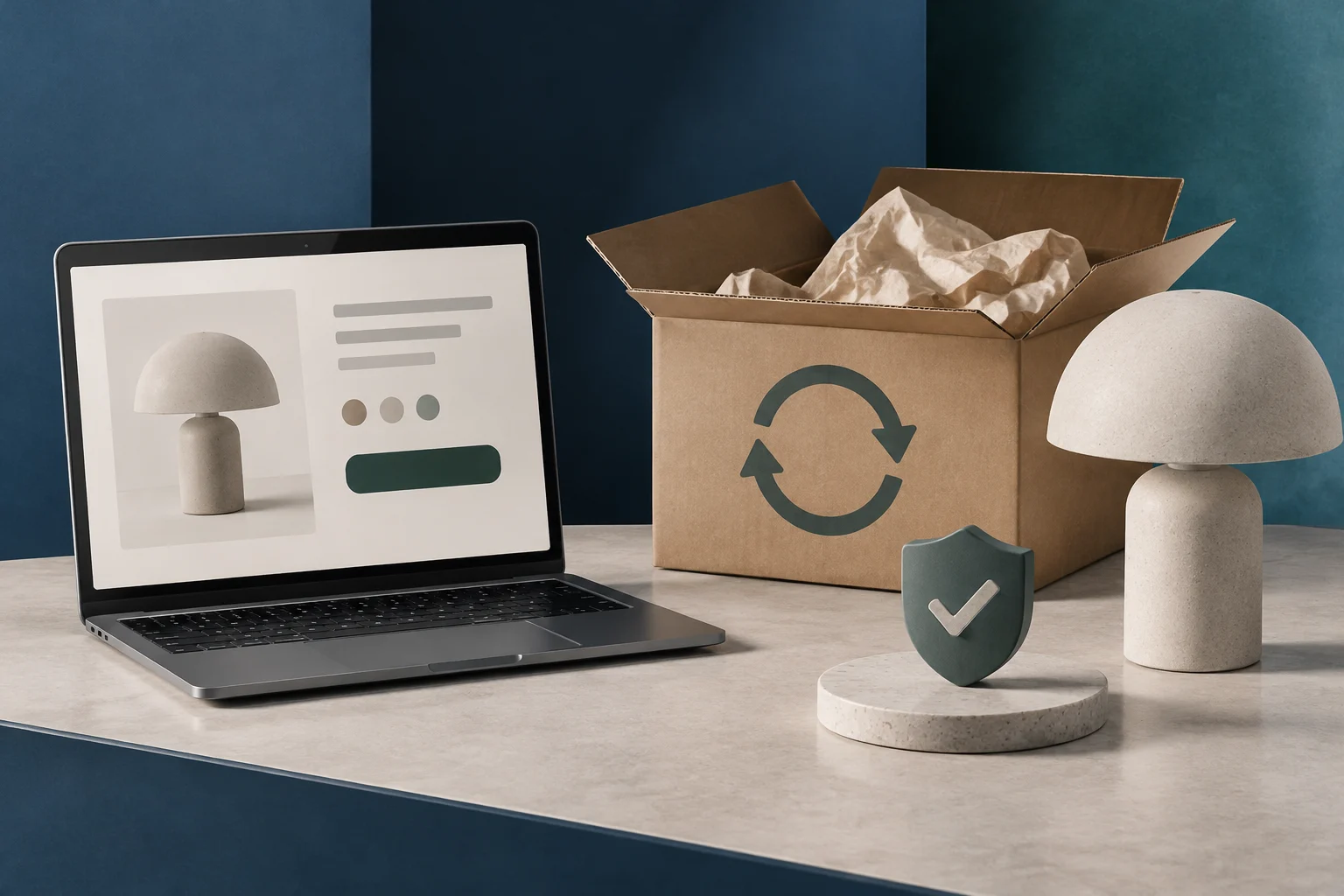
AI-generated conceptual illustration · Edition Business
Who pays for return shipping?
If the consumer exercises the right of withdrawal, they may be responsible for the return costs, including packaging and shipping. The European information identifies two exceptions: the seller agrees to pay those costs, or the seller did not inform the consumer about them before purchase. The terms should therefore be communicated in advance and not left until the customer asks to return the order.
This allocation of costs applies to withdrawal. It should not be confused with dealing with a defective product or one that does not match what was advertised, which is governed by the rules on the legal guarantee and conformity.
Withdrawal and defective products: two different situations
The right of withdrawal allows consumers to cancel certain distance contracts within the legal period without needing to claim a defect. By contrast, if a product is damaged, does not work or does not conform to what was advertised, the customer can make a claim based on that lack of conformity. The official information consulted identifies repair, replacement, a price reduction or a refund as possible remedies, as applicable.
To handle these claims, the business should establish what happened, keep a record of the communication, and clearly explain the next steps and the remedy being offered. The specific response depends on the circumstances of the case and the rules applicable to the product; not every disagreement about a return amounts to a defect.
In Spain, the legal guarantee for new products is three years, according to information from the European Consumer Centre in Spain. Its duration and scope may vary depending on the type of product, contract and rules in force. In addition, the EU has approved changes to strengthen repair rights: the source consulted states that, when a consumer opts for repair, the legal guarantee will be extended by an additional 12 months. It also indicates that the obligation to offer repairs after the guarantee expires is limited to certain products, and that Member States had to incorporate the relevant directive into their national law before July 31, 2026. That deadline has passed; the documents provided do not confirm whether Spain has completed the transposition or what its effective scope is. The business should check the national rules in force before applying these changes.
What changes with the withdrawal button
The application date indicated by the European Consumer Centre in Spain, June 19, 2026, has passed. According to the information provided, from that date European rules require online stores operating in the EU to include a clearly visible button or link—for example, “Withdraw from the contract”—to make it easier to cancel distance purchases. The system must allow consumers to submit their request simply and directly and receive immediate confirmation.
For businesses, this means reviewing the withdrawal experience on their websites and apps: access must be visible, and the process should not be hidden behind complex forms or unnecessary steps. The source provided describes the planned date and requirements, but does not document their effective implementation or any subsequent national provisions. Businesses should check the rules currently applicable to them before determining what specific measures are required.
Clearer claims handling
A useful internal process can distinguish three issues from the first point of contact: whether the customer is exercising the right of withdrawal within the time limit; whether they are making a claim for lack of conformity; or whether they are requesting a return under a voluntary commercial policy. This classification helps ensure that the correct terms are applied, without treating rights with different legal grounds as equivalent.
It is also useful for the customer service team to be able to retrieve the information provided before purchase and the order confirmation. If after-sales telephone support is offered to consumers, calls about enquiries or complaints must be charged at the basic rate, not through higher-cost numbers or premium-rate services.
Rules may vary depending on the product, the type of contract and legal exceptions. This guide provides general guidance for businesses selling to consumers in Spain and the EU; it does not replace checking the rules applicable to each offer.
What on-time delivery, fleet utilization, empty miles and other indicators measure, how to calculate them, and what precautions to take to turn them into useful decisions.
A practical guide to reviewing targets and revenue, understanding conversions and opportunities, distinguishing activity from results, and ending the monthly meeting with actions, owners, and deadlines.
A checklist for defining criteria before receiving proposals, comparing total cost, and evaluating quality, delivery times, terms, and risks using a common scale.