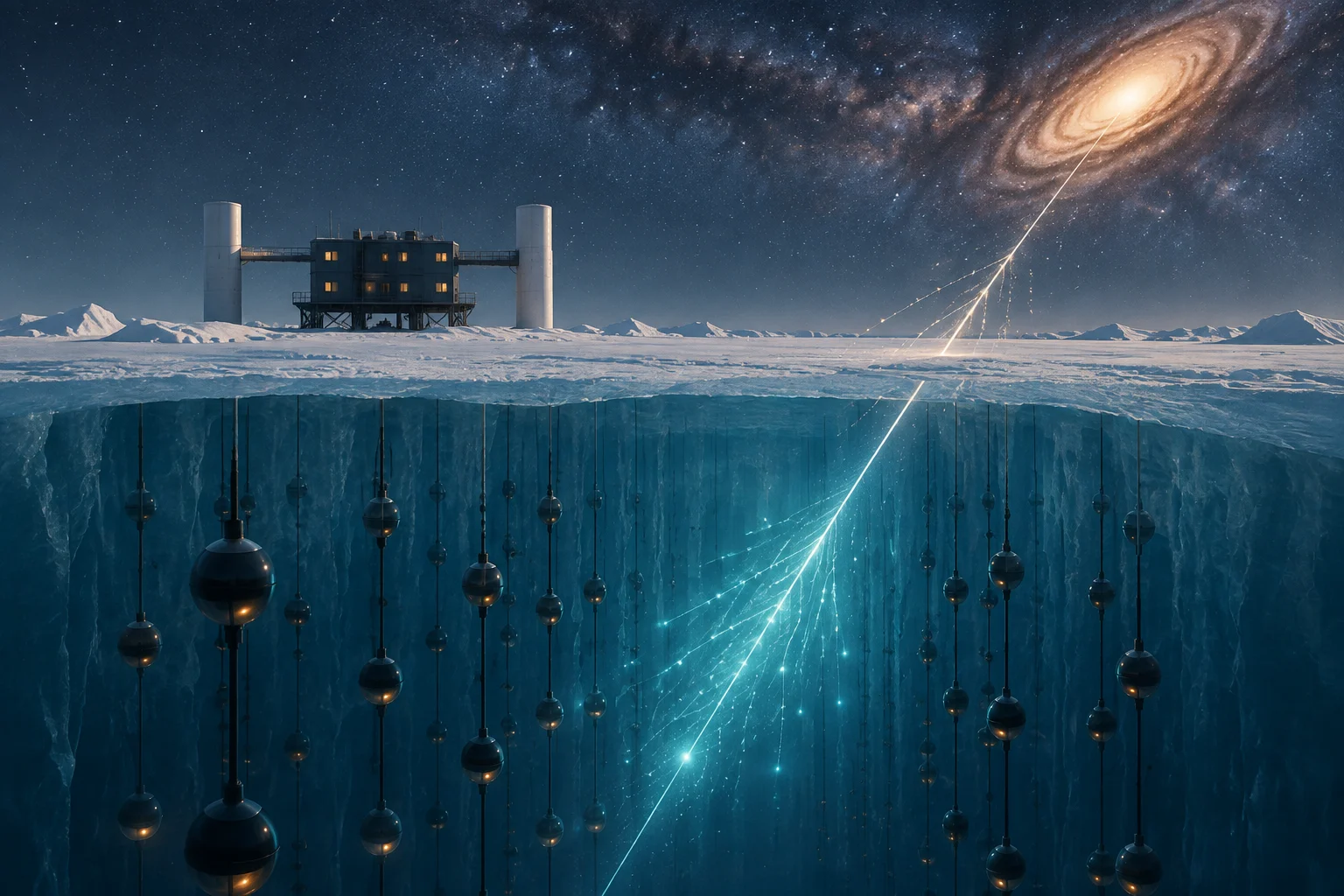
The Royal Swedish Academy of Sciences awarded the 2026 Nobel Prize in Physics to physicist Francis Halzen for his decisive contributions to the IceCube Neutrino Observatory and the discovery of high-energy neutrinos of astrophysical origin. The recognition puts the spotlight on a singular scientific proposal: turning the deep ice of Antarctica into a detector for particles that are almost impossible to observe.
Halzen, who was born in Belgium and is a professor at the University of Wisconsin–Madison, presented the idea of using the ice at the South Pole to track neutrinos in 1988. The Academy highlighted his vision and scientific leadership in developing IceCube, an observatory that occupies a cubic kilometer of ice and is equipped with light sensors. The detector was completed in 2011.
Why detecting neutrinos matters
Neutrinos are subatomic particles that interact very little with matter. Millions continuously pass through the Earth and our bodies without leaving perceptible traces. That same property, which makes them difficult to detect, allows them to travel from distant regions of the cosmos without being deflected or losing energy in the same way as other particles.
For this reason, high-energy neutrinos can offer clues about highly energetic astrophysical phenomena. The Academy noted that IceCube can detect particles from processes that occurred in the distant universe; studying them may provide information about cosmic sources that still raise questions for scientists.
How IceCube works
Detection depends on a neutrino occasionally colliding with an atomic nucleus in the ice. This interaction produces a flash of light that sensors installed in the detector can record. Since collisions involving high-energy cosmic neutrinos are rare, an enormous volume of material is needed to increase the chances of observing them.
The observatory does not directly capture all the particles that pass through the planet: it identifies the light signals left in the ice by some interactions. The observations made it possible to detect high-energy neutrinos and, later, to publish the discovery of neutrinos originating outside the solar system.
An award for a collective scientific endeavor
When announcing the award, the Academy’s Secretary General, Ellen Moons, described neutrinos as “ghostly messengers from space.” Halzen said the news took him by surprise and expressed his joy. He also said he hoped the award would help recognize the people who joined the project in its early stages.
The Nobel Prize recognizes Halzen’s decisive contributions to the observatory and to the discovery of astrophysical neutrinos. The physicist’s own reaction, when he mentioned those who took part in the project’s beginnings, is a reminder that IceCube is a scientific infrastructure developed with the support of a team of researchers, not an isolated individual achievement.