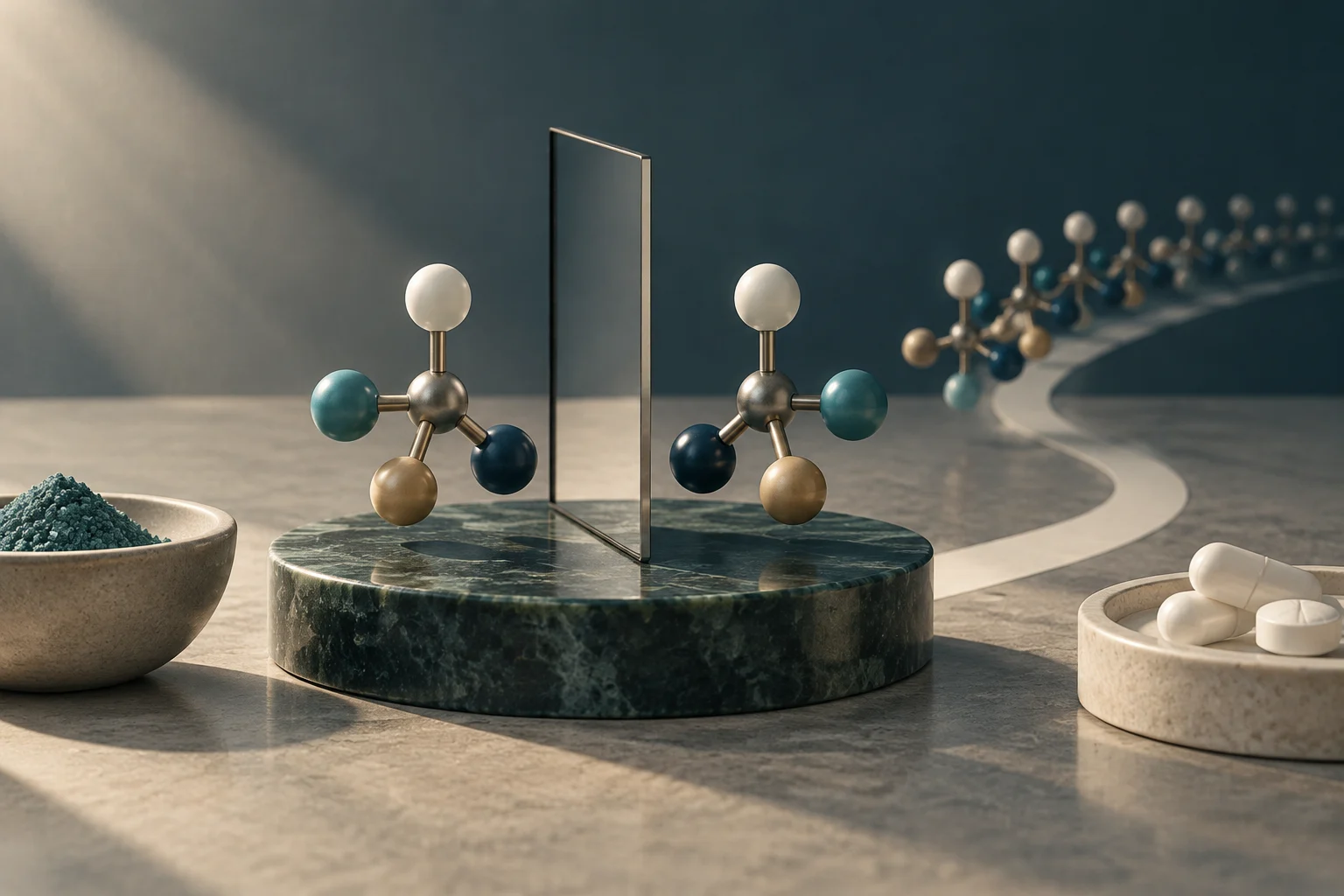
The Royal Swedish Academy of Sciences awarded the 2026 Nobel Prize in Chemistry to Henri B. Kagan and Kenso Soai for their discoveries on nonlinear effects and autocatalysis in asymmetric organic synthesis. The Academy thus recognized a line of research that helps explain how a reaction can favor one of the two mirror-image forms of a molecule rather than produce them in equal amounts.
The advance is of interest to companies and laboratories that design chemical reactions: a molecule’s spatial form can influence how it interacts with living systems. However, the prize recognizes fundamental findings and tools for guiding synthesis; it does not mean that all medicines or other products must necessarily be produced in a single molecular form.
Why chirality matters
Some molecules exist in two versions that are mirror images of each other, like right and left hands. They are called enantiomers. Although they have the same composition, their spatial arrangements differ, which can cause them to behave differently when interacting with other molecules.
Homochirality describes the predominance of just one of these orientations in a group of molecules. In living organisms, for example, proteins are made up of amino acids with a particular orientation. For a long time, chemists wondered how this preference could arise: in certain laboratory reactions, the two forms were generated in equal proportions.
The difference between the two versions is also relevant to the development of drugs and other substances intended to interact with living organisms. Controlling which form a reaction produces can be important for obtaining the desired properties. The specific benefit depends on the substance and the process; the award-winning findings do not mean that one form always has a desirable effect and the other a harmful one.
From nonlinear effects to autocatalysis
Kagan’s work, which began in 1986, showed that small differences in the composition of a catalyst could disproportionately influence the outcome of a reaction. Under certain conditions, some combinations of catalyst molecules work better than others. This nonlinear behavior can amplify an initial advantage and produce an excess of one enantiomer greater than previously thought possible.
Soai later developed research on autocatalysis: a process in which a reaction product helps generate more of itself. In a 1995 publication, he described a reaction with autocatalytic potential, and in 2003 he presented one in which one of the mirror-image forms was produced in a much higher proportion than the other. In this way, a small difference could be amplified as the reaction progressed.
This sequence of studies does not, by itself, demonstrate how homochirality arose in the earliest living systems. It does provide chemical mechanisms for studying how a molecular preference can emerge and grow, a problem that is also of interest to research into the origins of life.
Applications and limitations for industry
For industrial and pharmaceutical chemistry, controlling the orientation of molecules can help design more selective synthesis processes. The Academy linked the discoveries to the development of asymmetric reactions; coverage of the announcement also points to possible uses in the manufacture of drugs and other products, such as fragrances or agrochemicals.
The practical scope depends on each reaction, compound, and application. The Nobel does not establish that all industrial processes can directly adopt the Soai reaction, or that the findings, by themselves, guarantee safer or more effective products. Their significance lies in broadening our understanding of how the formation of a particular molecular form can be favored and amplified.