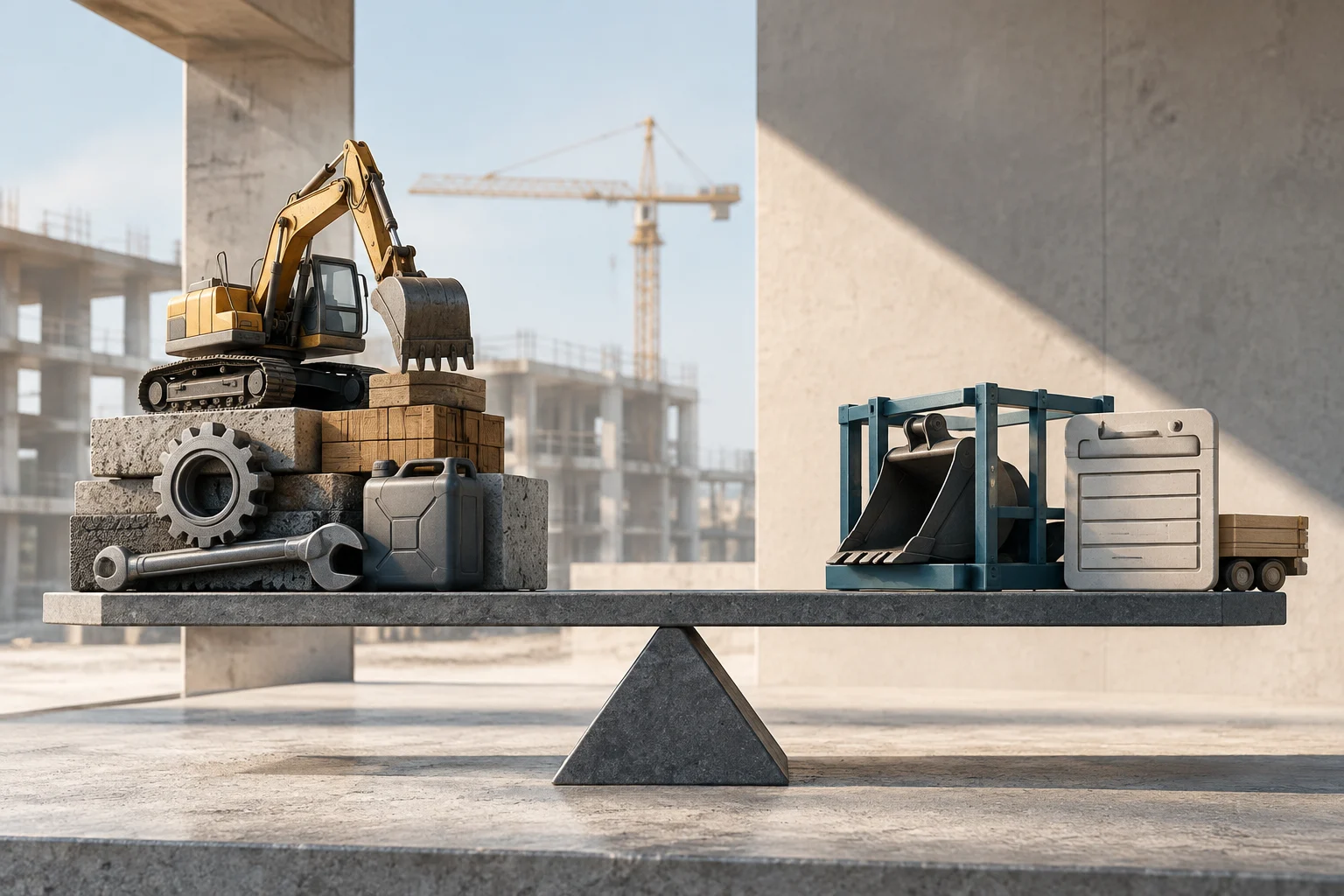
Guide to deciding between buying, renting, or leasing construction machinery
Practical contrast of purchase, rental, leasing, and renting for construction companies in Spain. Analyzes total cost of ownership (TCO), taxation, maintenance, and operational flexibility to optimize liquidity and profitability for each project.
The decision on how to access construction machinery is not merely financial; it is an operational strategy that determines liquidity, the capacity to take on new works, and the final profitability of the company. In the Spanish context, many construction companies make costly errors when choosing between purchase, rental, leasing, or renting based solely on the sticker price, without analyzing the total cost of ownership (TCO) or the actual utilization of the equipment.
The four models of access to machinery
To make an informed decision, it is fundamental to distinguish between the four main modalities available in the market, as each responds to different needs of capital and risk.
1. Direct purchase
This involves the acquisition of the asset, which becomes part of the company's balance sheet. It is the option that offers the greatest control and customization, allowing the equipment to be modified and maintenance to be scheduled at convenience. However, it requires a high initial outlay (CAPEX) and assumes the risk of depreciation and resale.
2. Rental (Short-term operational lease)
This is temporary access to equipment through the payment of a daily, weekly, or monthly fee. It is ideal for one-off projects or seasonal demand peaks. The lessor usually assumes maintenance and logistics, which turns the expense into OPEX (operational expense) that is immediately deductible.
3. Leasing (Financial lease)
This is a medium- or long-term contract (usually 3-5 years) that allows the use of machinery without significant initial investment. Unlike rental, the lessee is usually responsible for maintenance, but at the end of the contract, they have the option to purchase at a previously agreed residual value. The installments are tax-deductible.
4. Renting
This is defined as a long-term rental with a fixed fee that includes additional services such as maintenance, repairs, insurance, and technical assistance. Unlike leasing, it does not offer a purchase option at the end of the contract. It is the most flexible modality to avoid technological obsolescence and manage operational risks.
When to choose each modality: Decision criteria
The optimal choice depends on three key variables: the useful life of the equipment, the frequency of use in the portfolio of works, and the speed of technological obsolescence. As a general rule, if equipment will be used more than 60% of the time for more than three years, purchase or leasing with a purchase option are usually more profitable. Below that threshold, renting or flexible rental protects against unnecessary fixed costs.
Type of machinery
Recommended modality
Main reason
Excavator / Backhoe
Leasing or purchase
High continuous use, long useful life
Tower crane
Purchase / Sale & Leaseback
Strategic asset, high investment
Dumper / Concrete mixer
Leasing or renting
Frequent but not permanent use
Mini excavator
Renting
Versatility, low risk of obsolescence
Aerial platform
Renting
One-off use, maintenance included
Electric / sustainable machinery
Short-term renting
High obsolescence, rapid technological evolution
AI-generated conceptual illustration · Edition Business
Total cost of ownership (TCO): The key indicator
Comparing only the purchase price against the rental fee produces an incomplete analysis. TCO allows valuing the investment by adding all costs associated with owning and using the machine during a certain period.
For purchase, TCO includes:
Acquisition price and financing (interest).
Insurance, preventive maintenance, and repairs.
Storage, transport, and consumables.
Depreciation and residual value.
Costs of periods without utilization.
For rental or renting, TCO focuses on:
Daily, weekly, or monthly fee.
Effective duration of the contract.
Delivery and collection logistics.
Fuel or energy (depending on the contract).
Responsibilities for damages and penalties for cancellation.
Fiscal and financial impact in Spain
From an accounting and tax perspective, the distinction between CAPEX and OPEX is crucial for cash flow management.
Purchase (CAPEX): Recorded as a capital investment. The equipment is depreciated, strengthening the balance sheet, but immobilizes liquidity.
Rental and Renting (OPEX): Considered operational expenses. Installments are usually 100% deductible immediately in the tax return, which simplifies management and improves short-term cash flow.
Leasing: Installments are tax-deductible, offering a balance between liquidity protection and the possibility of acquiring the asset at the end of the contract.
Additionally, renting usually includes own damage and circulation insurance (if the machine is registered), transferring the risk of accidents and breakdowns to the lessor, a determining factor in the legal security of the work.
Data to collect before deciding
To apply this decision framework, the company must collect the following internal data before negotiating with suppliers:
Actual utilization rate: How many hours per month will the machine actually work?
Project duration: Is it one-off use (less than 6 months) or continuous (more than 3 years)?
Immobilization cost: How much does it cost to store the machine when not in use?
Maintenance capacity: Does the company have its own workshop or does it depend on third parties?
Estimated residual value: What would the machine be worth at the end of the usage period?
Conclusion
There is no universally superior modality. The objective is not to decide generally whether buying is better than renting, but to determine which option offers the lowest total cost for a specific need. The flexibility of renting protects liquidity and updates technology, while purchase or leasing maximizes profitability in equipment with intensive use and long useful life. A decision based on real utilization data and TCO avoids errors that can cost thousands of euros per year in hidden costs and lost opportunities.
Reminders can encourage attendance, but there is no one-size-fits-all formula. A small-scale test combining easy confirmation, advance cancellation, and filling vacated slots can help assess results while keeping accessibility and workload in view.
Strategic guide for operations and logistics directors in SMEs. Discover how to anticipate seasonal variability through data analysis, supplier diversification, and operational flexibility to prevent collapse and maintain efficiency.
A practical method for small construction businesses: verify receipt, record exits linked to budget items, compare actual consumption with forecasts, and classify the causes of differences to protect the budget.