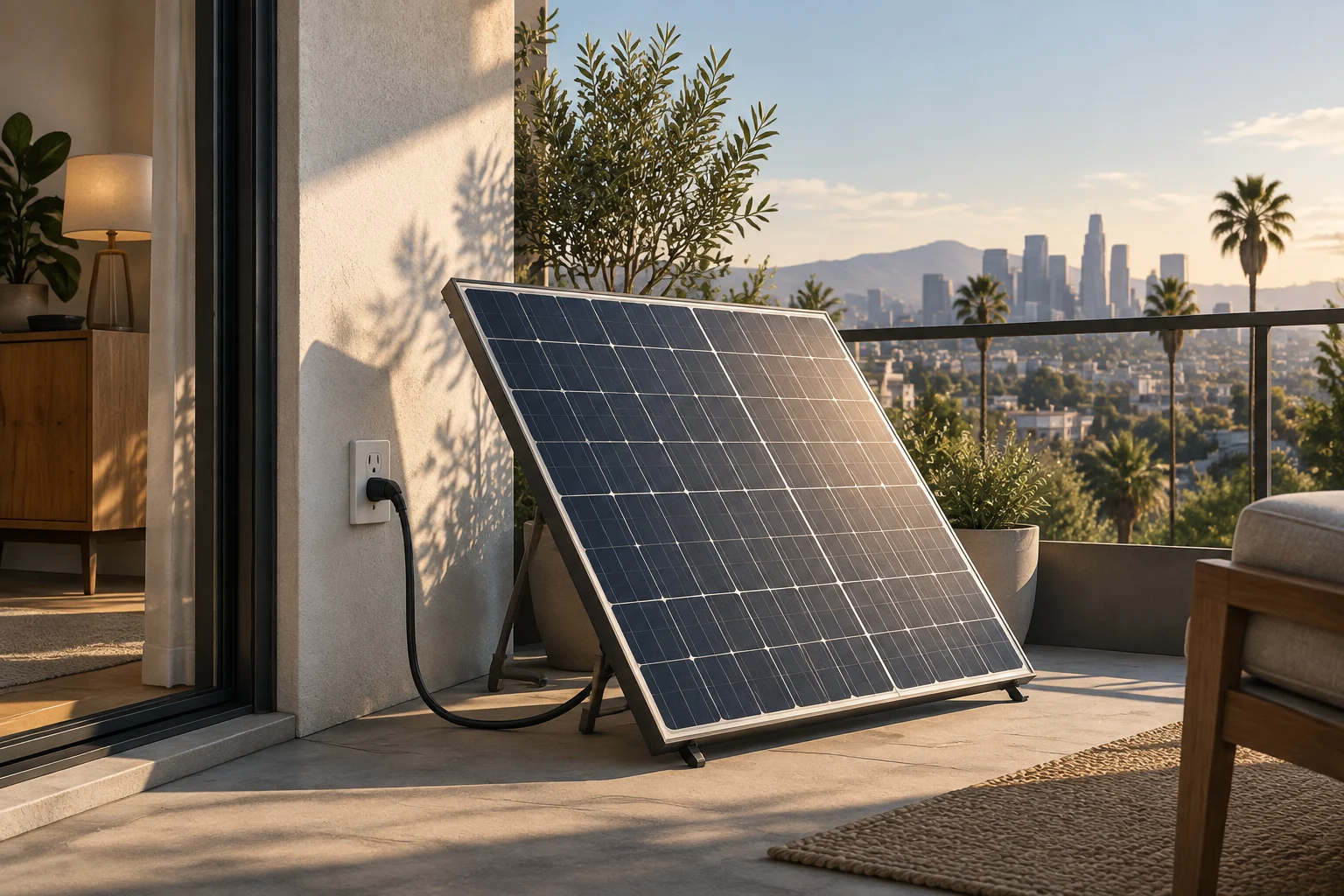
California Governor Gavin Newsom signed SB 868, a law that paves the way for small solar systems connected to a household outlet. The measure, sponsored by State Senator Scott Wiener, will allow households with panels on balconies, patios, or other sunny spaces to reduce the electricity they buy from the grid without going through the standard interconnection process with the utility.
The change could expand access to solar generation for renters and residents of homes where installing rooftop panels is not feasible. For energy companies, manufacturers, retailers, and property managers, it also establishes a new framework for marketing and using this equipment in California.
What the law allows and when it will take effect
SB 868 sets a maximum of 1,200 watts of alternating current per household. Systems may be connected to a household outlet and generate electricity for use in the home. The measure eliminates the standard interconnection agreement and the fees associated with the equipment, but not all communication requirements: utilities may request a simple digital notification with details such as the address and device specifications.
The law will take effect on January 1, 2027. Until then, the utilities’ current rules will continue to apply. The exemption from interconnection procedures is in effect until January 1, 2030, unless the Legislature extends it.
Simplified administration does not eliminate safety requirements
The equipment must have a safety certification from Underwriters Laboratories (UL) or another recognized equivalent testing organization. It must also include protection that stops electricity from being sent to the grid during an outage. These conditions are intended to limit the risks associated with connecting household generation to an electrical installation.
The availability of compliant products will depend on manufacturers obtaining the required certifications. Therefore, the law’s approval does not mean that any kit available online can be installed under the new framework, or that certified equipment is already on sale. Supply could develop during 2027, according to information reported by Infobae.
A market opportunity shaped by adoption
The measure creates a pathway for manufacturers and distributors to serve households that have so far faced administrative barriers to installing small systems. It may also be relevant to companies that manage rental properties: although the law covers both tenants and property owners, adoption will depend on the characteristics of the property and on whether owners or associations allow the equipment to be installed.
The economic impact on each household will vary according to consumption, location, and system performance. Quartz cites estimates from advocates of the technology that point to potential bill reductions, but these are not outcomes guaranteed by the law. Merca2, in turn, presents savings and payback projections based on other contexts; they should not be interpreted as a guarantee applicable to all California households.
Objections and limitations of the measure
Utilities such as Pacific Gas and Electric (PG&E) and SDG&E opposed the initiative because of safety concerns and the potential allocation of grid maintenance costs. PG&E spokesperson Paul Doherty said, according to Infobae, that aspects relating to consumer protection, standards, affordability, and operating rules still needed to be clarified. Certification and protection requirements were incorporated into the legislative framework, but the law does not by itself resolve all the concerns raised by utilities.
SB 868 is limited to California and to systems that meet its conditions. Its effective implementation will depend on equipment certification, availability, and the practical rules governing notification. For businesses, the key point is that the state is opening a new channel for distributed generation, but with a defined period of validity and technical controls that determine which products may be sold and installed.