Guide to calculating the cost and margin of each dish in a restaurant
Discover how to apply menu engineering to calculate the real cost of your recipes, distinguish between food cost percentage and contribution margin, and optimize your menu through the analysis of stars, plowhorses, puzzles, and dogs.
The financial management of a restaurant goes far beyond adding up the price of ingredients. To make strategic decisions about the menu, it is fundamental to master menu engineering, a methodology that combines recipe cost analysis with sales data. The objective is to identify which dishes truly generate profit and how to adjust prices, portions, or presentation to maximize profitability without sacrificing popularity.
From gross cost to real cost: the impact of waste
A common error is calculating the cost of a dish by summing only the price of the ingredients in their raw state. However, this approach systematically underestimates the actual expenditure. The key is to apply yields and prep loss.
For example, the cost of a roasted chicken thigh is not the price of the raw thigh, but the cost of the edible meat after removing bones, skin, and fat. If a recipe uses sub-recipes (such as a sauce or a side dish), the cost must be correctly cascaded from the base ingredients to the final dish. Ignoring these wastes hides costs that erode profits at the end of the month.
Contribution margin vs. Food cost percentage
There is a frequent misunderstanding: believing that a low food cost percentage guarantees higher profitability. The key metric is the contribution margin, defined as the difference between the selling price and the variable cost of the dish.
Consider two examples:
Chicken sandwiches: Cost of $1.00, Price of $3.00. Menu cost: 33%. Contribution margin: $2.00.
NY Strip Steak: Cost of $2.50, Price of $5.00. Menu cost: 50%. Contribution margin: $2.50.
Although the steak has a higher cost percentage (50% versus 33%), it generates more absolute money per unit sold ($2.50 versus $2.00). The food cost percentage is a reactive metric that indicates where you have been; the contribution margin is proactive and shows how much real money the operation retains for each dish served.
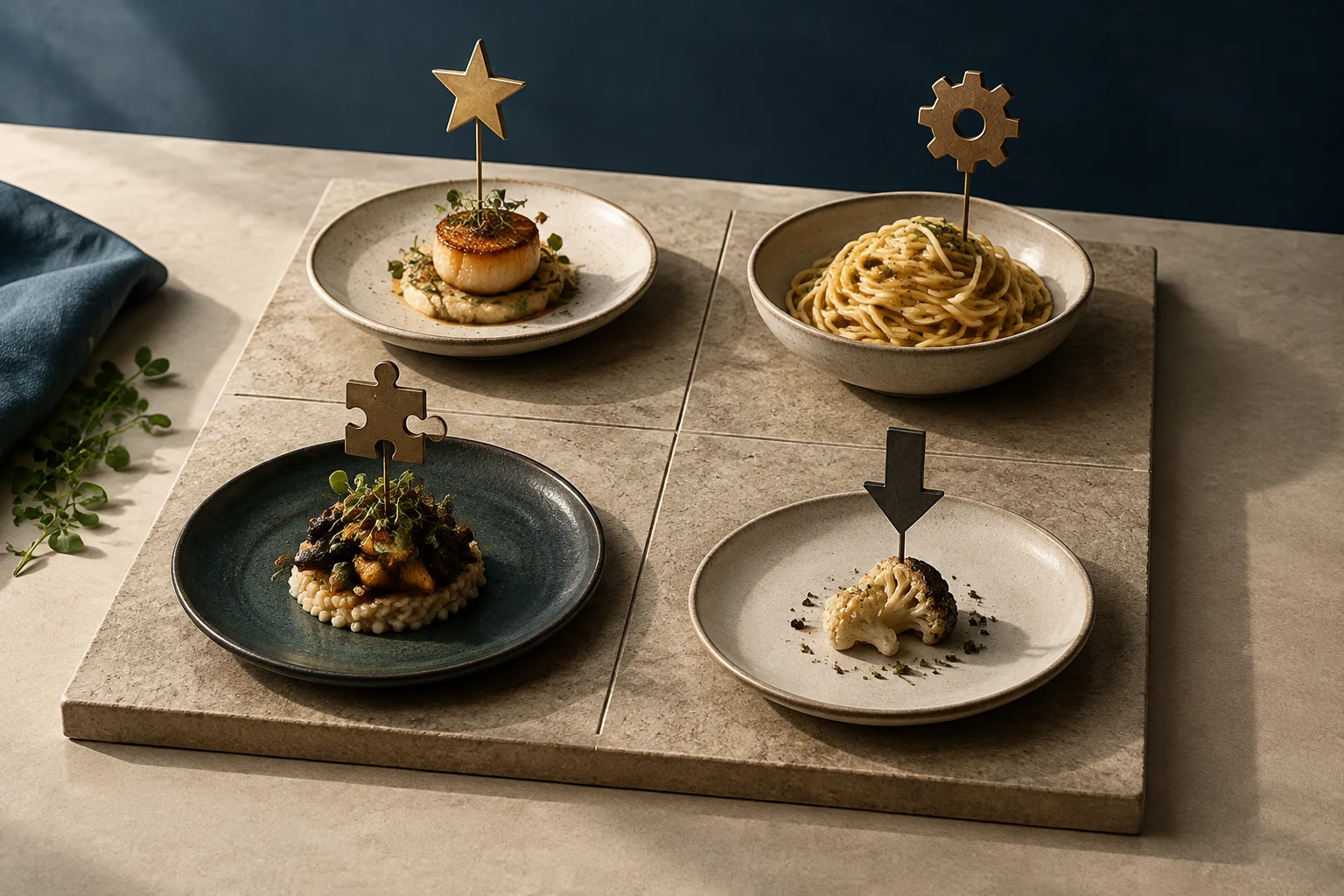
AI-generated conceptual illustration · Edition Business
The menu engineering matrix
Once the contribution margin and popularity (units sold) of each dish are calculated, the menu can be classified into a 2x2 matrix. This visual tool allows for immediate tactical decisions:
Category
Popularity
Contribution Margin
Recommended Strategy
Stars
High
High
Protect and highlight. They are the anchors of the menu.
Plowhorses
High
Low
Review costs or adjust prices. They are popular but not very profitable.
Puzzles
Low
High
Reposition or improve the description. They have unexploited financial potential.
Dogs
Low
Low
Eliminate or reformulate. Only keep if they fulfill a specific strategic purpose.
How to interpret the categories
Stars: They must remain visible and should not undergo changes that alter their appeal. They are the basis of profitability.
Plowhorses: They cannot be eliminated due to high demand, but they require optimization. You can adjust the portion size, change ingredients for more economical alternatives, or try a slight price increase.
Puzzles: They are financially attractive but do not resonate with the customer. The solution is usually marketing: improve the location on the menu, train the floor staff to recommend them, or improve the photography and description.
Dogs: They are generally candidates for elimination. A leaner menu improves kitchen execution, reduces inventory complexity, and focuses customer attention on the strong dishes.
Tools and automation
Manual cost calculation is prone to errors and time-consuming. Recipe and cost management platforms offer significant advantages:
Automatic update: They synchronize supplier prices with recipes, recalculating the cost of each dish in real time.
POS integration: They connect cost data with actual sales, allowing the menu engineering matrix to be generated automatically.
Scenario testing: They allow simulating the financial impact of changes before implementing them. For example, what happens to the margin if I reduce the cheese portion from 2 oz to 1.75 oz? How does a price increase of $1.50 affect profitability?
Steps to implement menu engineering
Gather ingredient data: Ensure you have current prices for all inputs, including sub-recipes.
Calculate the real cost: Apply yields and waste to each component.
Obtain sales data: Extract the units sold of each dish from your POS system for a representative period (e.g., 4 weeks).
Calculate the contribution margin: Selling price - Real cost of the dish.
Classify in the matrix: Divide the menu into Stars, Plowhorses, Puzzles, and Dogs.
Apply strategies: Review prices, portions, presentation, or eliminate dishes according to their category.
Monitor and adjust: Repeat the process periodically, as supplier prices and customer preferences change.
Menu engineering is not a one-time exercise, but a continuous process. By keeping costs updated and analyzing the performance of each dish, restaurants can increase their profits sustainably, often between 10% and 15%, without the need to increase sales volume.
Booking platform (OTA) commissions are just the tip of the iceberg. This analysis provides a method to audit the real Customer Acquisition Cost (CAC), integrating hidden costs such as price erosion and the loss of customer data, to optimize the net profitability of the accommodation.
A comprehensive framework for banks and fintechs covering technology selection (NFC, QR), secure integration via tokenization, user experience optimization, and regulatory compliance to maximize adoption and reduce risk.
Revenue is not synonymous with profit. For a private clinic in Spain, the key is to apply cost accounting to separate income from direct and indirect expenses. This analysis explains how to estimate the actual margin of each service and use the data to adjust prices and capacity.