From building a car as a team to assembling it in motion
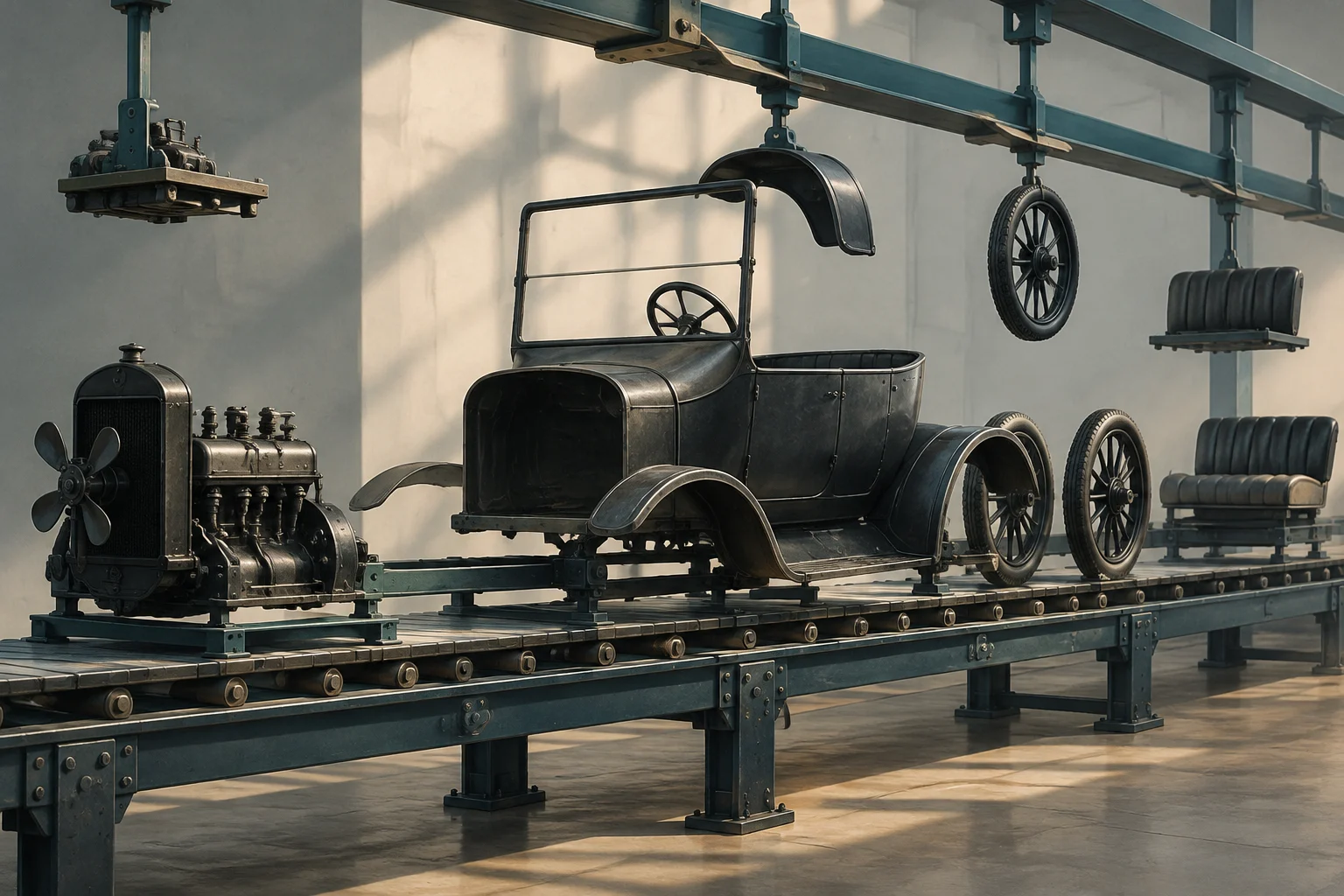
Before the assembly line, workers gathered around a vehicle and worked together to complete it. Ford changed that approach: it brought components to the workers and divided assembly into specific, repeatable tasks. The car thus moved through different stations instead of each team building an entire vehicle.
The transformation was gradual. According to Momentos del Pasado, Ford began testing the process in April 1913 and tried the method while manufacturing magnetos. Its account states that the time needed to assemble that part fell from about 15 minutes to 5, while the team assigned to the task shrank from 29 to 14 people. The company then extended the system to other components and to the chassis.
A key date, with differences between sources
Rankia dates the launch of moving chassis assembly at the Highland Park, Michigan plant to October 7, 1913. It describes a system in which a rope and a winch pulled the chassis past the workers. Motorpasión, by contrast, associates that date with assembly-line production on Piquette Avenue in Detroit. Meanwhile, Momentos del Pasado identifies Piquette Avenue as the place where the Model T was born in 1908 and where Ford introduced improvements before the transition.
The sources therefore do not fully agree on the place associated with October 7 or on how to date each stage. They do describe a process of testing and gradually extending production in motion, rather than an innovation introduced all at once.
Less time per unit and a lower price
Task specialization and the movement of parts sped up assembly. Rankia quantifies the change in chassis assembly: in just over a year, assembling a car went from 12 and a half hours to 93 minutes. Motorpasión also reports a reduction to 93 minutes, although it describes a different initial sequence: from 12 hours to 6, then to 3, and finally to that amount of time.
The shorter production time helped make the Model T less expensive, although the starting figures vary between the articles. Rankia gives a price of 850 dollars in 1908 and 260 in 1924; Motorpasión reports 825 dollars in 1908 and 260 in 1925. Both accounts point to a sharp price reduction over the years, but their figures do not support presenting a single starting price or the same final year as undisputed.
An innovation built on predecessors and specialized labor
Ford did not start from scratch. Motorpasión notes that Ransom Olds had patented an assembly system in 1901, and credits manufacturers such as Oldsmobile and Cadillac with making important contributions to automotive production. Ford’s contribution was to refine and expand the method in its plants, dividing the work into simple operations and moving components to the workers.
The change also reorganized work. According to Motorpasión, repetitive tasks and control over the pace of production were associated with high staff turnover. The article adds that in 1914 Ford doubled its employees’ daily pay to 5 dollars and established an eight-hour workday. This is a detail about the company’s policy reported by that source; it does not remove the demands or monotony that repetitive work could entail.
For businesses, the episode illustrates how redesigning the flow of materials and defining tasks can increase productivity. It also shows that a process’s efficiency depends on how work is organized: accelerating production, by itself, does not describe the experience of the people doing the work.