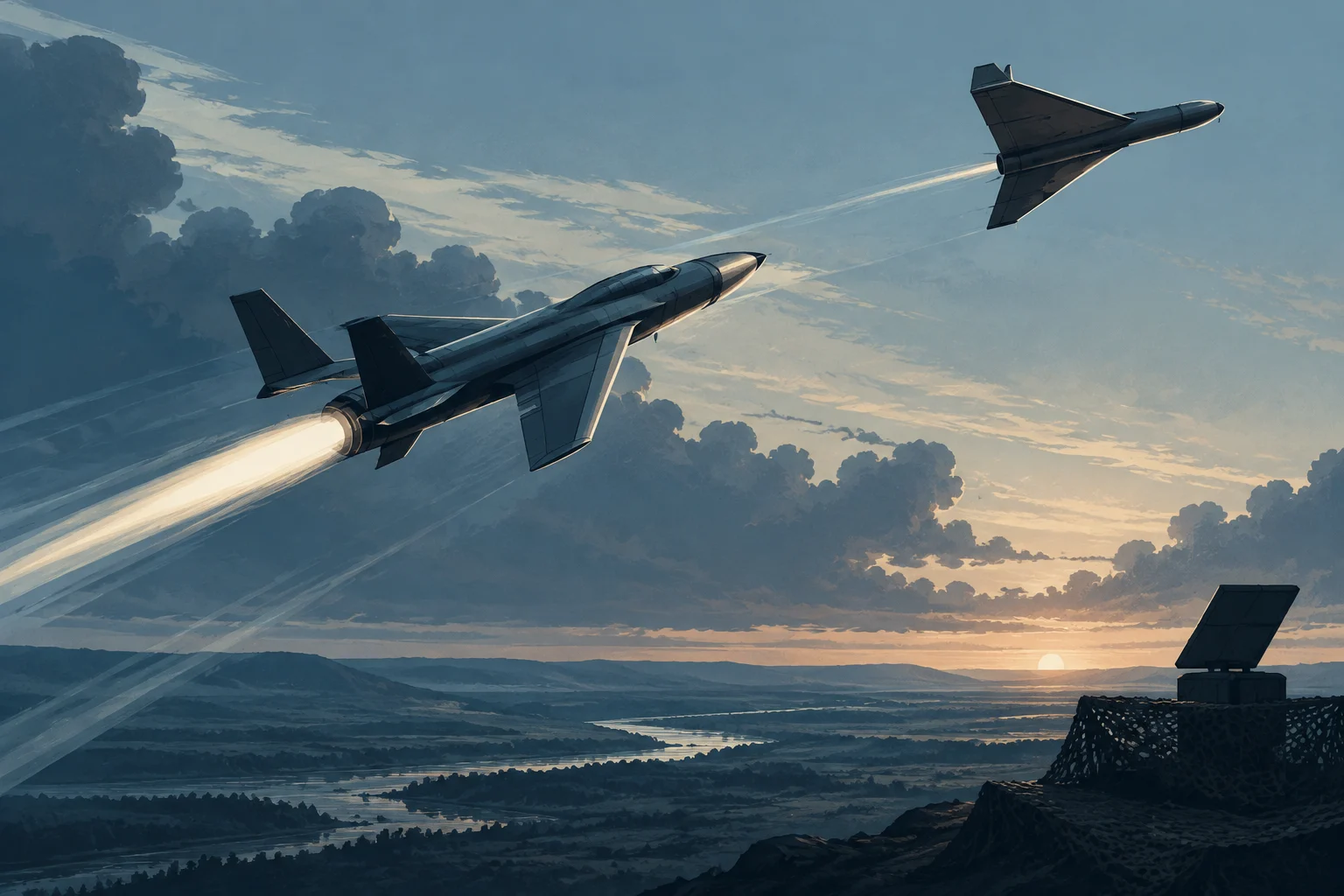
Russia is increasingly using attack drones with jet engines, which are faster than the propeller-driven models used previously. This shift is putting pressure on Ukrainian defenses and has opened a new line of development for defense companies in Ukraine, Europe, and the United States: interceptors that can not only detect these aircraft, but also reach them in flight.
The challenge is significant for companies because it combines accelerated innovation, urgent procurement needs, and technology being tested in combat conditions. However, the capabilities and results described by military personnel, officials, and manufacturers do not in themselves amount to an independent assessment of each system.
More speed, less time to respond
According to Business Insider, the Geran-5, the latest model in this Russian family, can reach about 375 miles per hour (around 600 kilometers per hour). El País also puts its top speed at around 600 kilometers per hour. These aircraft, with their narrow fuselages and turbojet engines, visually resemble cruise missiles, although they are classified as drones.
The difference in speed reduces the time available to detect, track, and intercept the target. It also means systems originally designed to stop slower, propeller-driven drones need to be reassessed. According to Business Insider, some Ukrainian units have already adapted their interceptors and shot down several Geran-5s, but defenses are still facing a higher proportion of jet-powered threats.
Figures on activity and effectiveness vary depending on the source and period cited. The Ukrainian Air Force reported, according to El País and Business Insider, that 2,800 jet-powered attack drones were launched in August, compared with 350 in June. President Volodymyr Zelensky said Ukraine shot down 55% of those drones in September; El País cites a Ukrainian estimate that the interception rate was as high as 60%. For propeller-driven models, Ukrainian officials had regularly put the rate above 90%. These figures are attributed to Ukrainian authorities and are not measurements independently verified in the available documents.
Faster interceptors, in Ukraine and abroad
Ukrainian manufacturers that developed an initial generation of interceptors are now working on faster versions. Business Insider identifies, among others, the Sting S, made by Wild Hornets, and the P1-SUN JetKiller, made by SkyFall, and reports that both have recorded combat kills. Valerii Zarubin, chief executive of BlueBird Tech, a Ukrainian company developing a jet-powered interceptor, summarized the challenge as the need to adapt to the propulsion and speed of the new threats.
The activity is also spreading to Western companies. France’s Alta Ares developed an interceptor for jet-powered drones after the NATO-Ukraine Joint Analysis, Training and Education Centre identified the possibility of a defensive gap. Ukrainian Colonel Volodymyr Gordiienko, who leads a program design branch at the center, described the work as a promising solution in development and argued for anticipating threats rather than waiting for the gap to emerge.
In Europe, Lithuania’s Granta Autonomy is studying a jet-powered version of its current interceptor; the Czech company LPP Holding is working to increase the speed of its JWI-4000 system; and Germany’s Tytan Technologies is developing a jet-powered interceptor intended to cover greater distances and operate at higher speeds. In the United States, Perseus Defense is designing a more powerful model to combat jet-powered drones. Its chief executive, Jason Cornelius, argues that the interceptor must be faster than its target, not merely match its speed. The company plans to test a prototype before the end of the year, according to Business Insider.
From innovation to supply
The challenge is not just to build a faster aircraft. It also requires testing its effectiveness, integrating it into existing defenses, and producing it in sufficient quantities. In Ukraine, Zelensky has said that 60 local companies are working on interceptors. At the same time, Ukrainian military analyst Oleksandr Kovalenko has warned, in comments reported by El País, that the available resources—including short-range missiles and portable air-defense systems—are scarce and cannot cover the entire airspace.
Western governments are beginning to translate technological interest into procurement processes. Luke Pollard, Britain’s Minister for Defence Readiness and Industry, has called faster interceptors a priority for the coming years. Lieutenant Colonel Matt Keogh, who is responsible for acquiring drone technology for the British Army, explained that the Rapstone program includes the purchase of interceptors and that the ministry is studying jet-powered models. According to Business Insider, the program is seeking solutions from British industry and expected to make a procurement decision before the end of the year.
The expansion of this technology presents an opportunity for suppliers, but also brings uncertainties typical of a rapidly evolving defense market: specifications must address changing threats, and testing, purchasing decisions, and deployments do not in themselves guarantee operational results. U.S. Lieutenant Colonel Adam Scher, a spokesperson for Joint Interagency Task Force 401, said development should address the physical principles of flight and not depend solely on a drone’s control method. The idea is to design capabilities that remain useful as aircraft models evolve.
The race, therefore, does not pit drone manufacturers against interceptor manufacturers alone. It also tests the ability of governments and armed forces to detect changes quickly, validate solutions, and turn prototypes into available systems. In an environment where the speed and volume of attacks can change within a few months, this capacity to adapt will be just as important as the advertised performance of each interceptor.